In this post I will discuss some research articles which has attempted to analyse policy scenarios in environmental system. Because both, policy making and environmental system are complex, choosing best alternative is often hard. Thus, my focus will remain in system thinking in environmental system that could support choice of best alternatives in environmental policies.
System Dynamics: System possess different subsystem and circular causalities among them. The advantage of system dynamics over other model is its ability to study whole system rather its element and identify how a causal loop can effect the whole system. The figure below describes system dynamics.
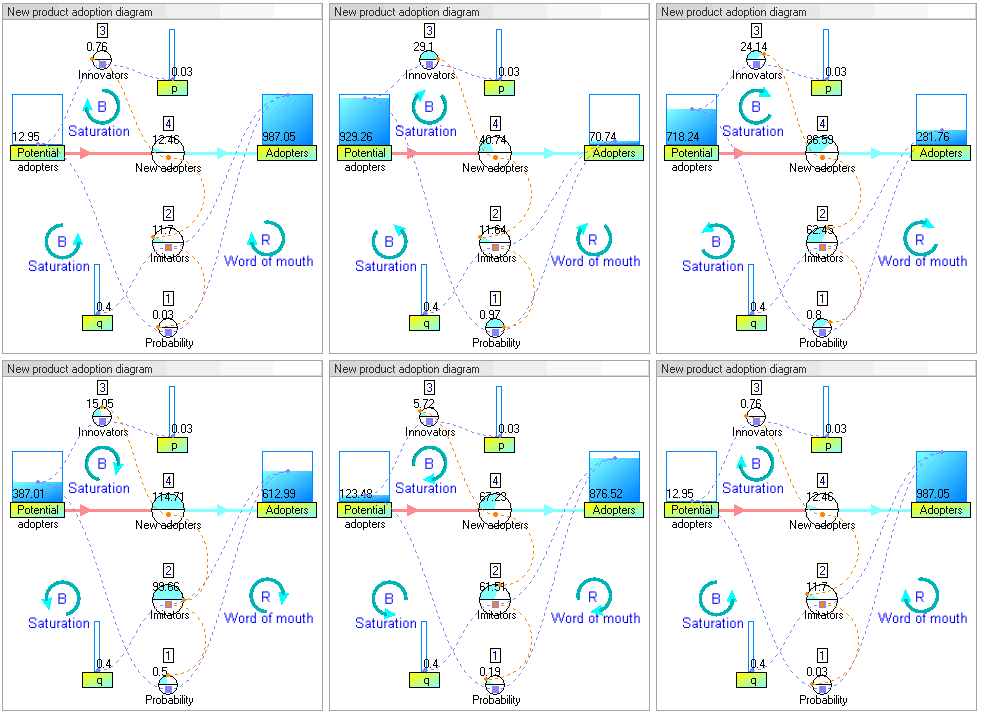 |
| An illustration of system dynamics. wikipedia.org |
Ghaffarzadegan et al. (2010) discuss about the usefulness of System Dynamics models (SD) in policy making with examples from urban planning and social welfare. They discuss some problem associated with public policy like resistance from environment, need and cost of experiment, persuade stakeholder, think of subsequent and indirect effects etc. They argue that even a simple system dynamics model with some important causal loops can also resolve policy problems through simulation or prediction.
Wang et al(2008) has studied a complex urban transportation system in China. They used Vensim PLE to simulate the effect of seven subsystem to the transport system. The model was validated by comparing real observation of 2005 with simulated estimates using 2000-2004 data. The sketch of the causal loops among subsystem is given in figure below.
 |
| Different subsystem and their relationship with each others. From Wang et al.(2008) |
Their focus variable was vehicle ownership which prevent environmental degradation by reducing emission. The result show that flexible restriction policies would help GDP and population grow without further degradation to environment. The main recommendation are a) restrict vehicle ownership that is acceptable, b) restrict private ownership with better public transportation and c) restriction policy implemented with research in emission reduction technology. This shows that different factors simultaneously affects the system and effective policy options can be developed with sets of variables to achieve sustainable development. (Wang, 2008).
Guan et al. (2011) attempted to couple GIS with system dynamics model to observe the effect of different policy scenario in urban system from 1453 village. SDM was developed and validated using cross section data. Different scenario was developed by varying parameter and variables like current with as usual, economy with higher input of capital and labor, resource with reduced elastic coefficient for resource related variable and environment scenario with higher investment in environment protection. SDM was used to simulation for 2050 AD. The 2050 result was used in GIS for spatial analysis. The figure below shows the result for sustainability. They conclude most effective scenario is environment.
Policy making in environmental system is also contained by engagement of different stakeholders and concern for economic loss. The paper discussed above are some policy studies which used System Dynamics modelling (SD), and suggest that it can be of help not only to understand complex environmental system but also to use it in simulating policy scenario and identifying appropriate strategy. There are several circular causalities among environmental intervention and socio-economic factor and all of them are important to human welfare. SD can help to track the option that has highest benefit to overall system.
Although it is hard to recommend what each should do to achieve the target of 2 degree Celsius. However I see SD can be used to simulate potential scenarios and find appropriate policy at regional and local level to ensure responsible contribution for global climate change mitigation.
Happy New Year 2016.
 |
| Simulated result for sustainability for different scenario. Adopted from Guan et al(2011) |
Although it is hard to recommend what each should do to achieve the target of 2 degree Celsius. However I see SD can be used to simulate potential scenarios and find appropriate policy at regional and local level to ensure responsible contribution for global climate change mitigation.
Happy New Year 2016.
